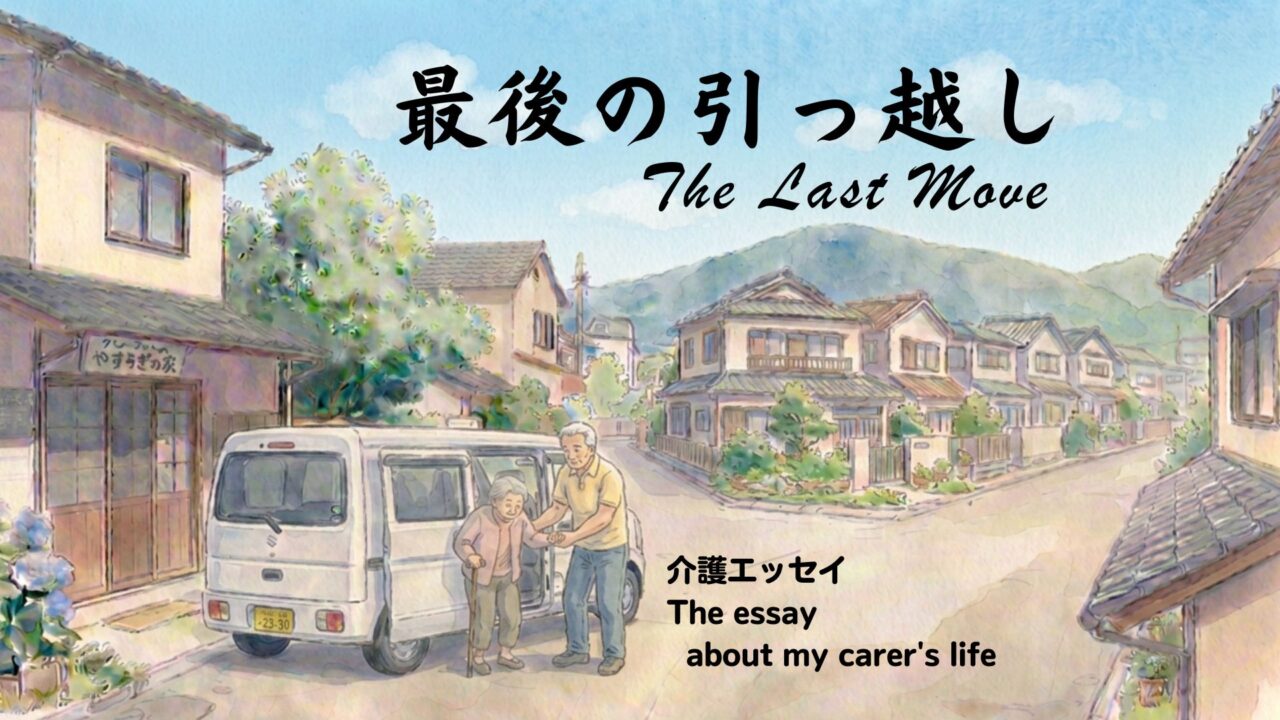
The essay about my carer’s life “ The Last Move”

編集委員会(スタッフ)/Staff 01
22/06/2026
The Japan Dementia International Exchange Platform is a place for people living with dementia and their caregivers to share experiences, feelings, and thoughts. We are looking forward to your post. Please join us.
Here is Mr. Fukui’s essay. He moved to his mother’s house in a southern prefecture from northern Japan to care for her, leaving his beloved wife and cats.
The Quiet Creep of Anxiety
The first time I truly began to worry about my Mom’s ability to continue living on her own came after she injured her left knee in the summer of 2025.
One day she started saying, “My knee hurts.”
Getting out of bed or standing up from a chair became a struggle. She would wince in pain and sometimes lose her balance, dropping back down onto the floor. Once she managed to get upright, she could still walk with her cane, but something about her movements seemed different from before.
Then I remembered something my wife had told me. She had come to check on us after finishing some business in Fukuoka, and while she was here, a neighbor mentioned that he had once found my mother lying in the shrubbery near the front entrance after a fall and had helped her back up.
Concerned, I examined her leg. Her ankles were always somewhat swollen, making it difficult to tell whether there was any new swelling from an injury. There were no bruises on the knee either.
To be fair, complaints about her legs were nothing new. In the mornings she would often say things like, “My leg is numb,” or “The top of my foot is cramping.” Usually, a little massage, some acupressure, and a mint candy presented as a miracle pill—“Take this one, it works wonders”—would somehow do the trick.
Still, I couldn’t help wondering.
Was this simply old age finally catching up with her legs? Had the fall caused more damage than we realized? Was she approaching the point where she might need a wheelchair?
One anxious thought followed another.
Around that time, I received a call from the care manager at the small community-based day care facility Mom attended every day.
“Your mother’s left knee appears swollen. We’d like her to see an orthopedic specialist.”
The care manager was also a qualified nurse, so I wasn’t surprised. With a sense of inevitability, I accompanied Mom by taxi to a nearby orthopedic clinic.
The diagnosis revealed no damage to her bones or joints. However, fluid had accumulated in her left knee, and the doctor drained it.
I worried about what might happen afterward, but within a few days she began to recover. After several follow-up visits, she was walking again and had largely returned to her usual routine.
It was certainly a relief.
Yet the episode forced me to confront something I had long tried to ignore. The old family home—about as far from barrier-free living as one could imagine—was becoming increasingly difficult and potentially dangerous for her.
What troubled me even more was how vulnerable she had become to the increasingly unforgiving climate.
She no longer understood how to operate the air conditioner remote control. During the relentless tropical nights of summer, I would set the temperature before leaving, only to discover later that she had somehow turned the unit off. If I hid the remote where she couldn’t reach it, she would open every door in the room, rendering the cooling almost useless.
Perhaps the difference in temperature simply felt cold to her.
Whatever the reason, I found myself worrying constantly.
Searching for a New Way Forward
Even after autumn officially arrived, the intense heat refused to let up.
After discussing the situation with family members and consulting with her care manager, I submitted an application for my mother to move into a local group home designed for people living with dementia.
When I toured the facility, I was struck by its atmosphere—safe, bright, and calm. The professionalism and kindness of the staff inspired confidence. And, truth be told, the comfortably maintained indoor temperature was also a persuasive factor.
Admission, however, depended on a waiting list.
And so we waited.
The seasons changed. A new year arrived.
During that time, the day-care facility that had supported my mother generously allowed her to stay overnight five nights a week. Yet the remaining two nights at home continued to weigh heavily on my mind.
Climate change may be warming the planet, but winter has not become any less capable of delivering bitter cold.
Years earlier, we had used a portable kerosene heater. For safety reasons, I replaced it with an electric heater whose glowing heating elements produced warmth without an open flame.
My mother would sit pressed against it for hours and eventually suffered low-temperature burns on her legs.
That would never do.
Next came a kerosene fan heater, which produced warm air without visible flames. For a brief moment, I thought I had found the answer. Then I discovered my mother had developed a habit of pulling out the fuel tank during operation to check how much kerosene remained.
That ended that experiment.
My final gamble was an electric panel heater.
It was safe and posed virtually no fire risk. Unfortunately, it warmed the room slowly and never gave the immediate sensation of warmth.
My mother would likely try to make it warmer by pressing buttons on the touch panel, only to switch the unit off entirely.
As a result, on nights when the north wind blew hard, the room temperature sometimes fell to around 5°C (41°F).
One particularly frigid morning, I returned to the house as usual to help her get ready for the day.
I heard her voice coming from the bedroom.
When I went in, I found her wrapped tightly in blankets, shivering. For some reason, her bare right foot was sticking out from beneath the covers.
I touched her foot and calf.
They were shockingly cold, almost devoid of warmth.
The electric blanket had been switched off as well.
I quickly massaged her foot, pulled on a thick pair of socks, wrapped her in the heated blanket, and kept rubbing warmth back into her skin.
As I sat there beside her, only one thought occupied my mind.
How are we going to get through this winter?
And when will the group home finally call?
Two days later, it did.
A New Beginning — The Last Move
The morning of my mother’s move into the group home finally arrived.
The air was cold, but the wind was still.
I loaded a few belongings into a rental car and drove to the small multifunctional care facility to pick her up. As planned, we stopped first at the designated hospital for a health checkup. Afterwards, we had lunch at a nearby conveyor-belt sushi restaurant.
My mother selected a few favorites from the plates I had gathered somewhat at random—tuna, steamed shrimp, inari sushi, and tamago. She then polished off a bowl of kitsune udon. Only the chawanmushi proved too much for her to finish.
From there, we headed toward the group home.
Of course, this was not a move that followed a careful explanation and wholehearted agreement on her part. Dementia had long since made such conversations impossible. As I drove, I wondered how I should respond if she became upset or refused to go inside.
Before I could organize my thoughts, we arrived.
Above us stretched a clear blue winter sky.
The moment I opened the car door, my mother looked up at the building and said,
“What a fine nursing home.”
To her, every elder-care facility was simply a “nursing home.”
Still, there was no sign of resistance in her voice.
I walked around to her side of the car, placed her familiar cane in her right hand, and gently took her left hand in mine.
“Well,” I thought, “here we are. The last move.”
Let’s go.
Then she said quietly,
“Your hands are cold.”
For a moment, I was taken aback.
And then I realized something.
It was not my hand warming hers.
It was hers warming mine.
The warmth of my mother’s hand.
It had been a long time since I had truly felt it.
Soft.
Familiar.
Comforting.
Wonderfully warm.
I cannot say with complete certainty that this move was the right decision.
Perhaps no one can ever be entirely sure of such things.
But at that moment, her hand seemed to tell me that we had chosen well.
The answer was there, in that gentle warmth.
Thirty-six point five degrees Celsius.
The temperature of a living hand.
The morning of my mother’s move into the group home finally arrived.
The air was cold, but the wind was still.
I loaded a few belongings into a rental car and drove to the small multifunctional care facility to pick her up. As planned, we stopped first at the designated hospital for a health checkup. Afterwards, we had lunch at a nearby conveyor-belt sushi restaurant.
My mother selected a few favorites from the plates I had gathered somewhat at random—tuna, steamed shrimp, inari sushi, and tamago. She then polished off a bowl of kitsune udon. Only the chawanmushi proved too much for her to finish.
From there, we headed toward the group home.
Of course, this was not a move that followed a careful explanation and wholehearted agreement on her part. Dementia had long since made such conversations impossible. As I drove, I wondered how I should respond if she became upset or refused to go inside.
Before I could organize my thoughts, we arrived.
Above us stretched a clear blue winter sky.
The moment I opened the car door, my mother looked up at the building and said,
“What a fine nursing home.”
To her, every elder-care facility was simply a “nursing home.”
Still, there was no sign of resistance in her voice.
I walked around to her side of the car, placed her familiar cane in her right hand, and gently took her left hand in mine.
“Well,” I thought, “here we are. The last move.”
Let’s go.
Then she said quietly,
“Your hands are cold.”
For a moment, I was taken aback.
And then I realized something.
It was not my hand warming hers.
It was hers warming mine.
The warmth of my mother’s hand.
It had been a long time since I had truly felt it.
Soft.
Familiar.
Comforting.
Wonderfully warm.
I cannot say with complete certainty that this move was the right decision.
Perhaps no one can ever be entirely sure of such things.
But at that moment, her hand seemed to tell me that we had chosen well.
The answer was there, in that gentle warmth.
Thirty-six point five degrees Celsius.
The temperature of a living hand.
With Gratitude
The following day, I sent the same letter to twenty-seven people who had supported my mother over the years.
Dear Friends,
The New Year has arrived, and the calendar has already advanced to Daikan—the “Great Cold,” a season whose very name seems enough to make one shiver. I hope this letter finds you well.
First and foremost, I would like to express my heartfelt gratitude for the kindness and concern you have shown my mother over the years.
I am writing to let you know that she recently moved into a group home here in town.
Seven years ago, at the age of sixty-two, I retired from my job and, with the understanding and support of my wife, moved to this town so that I could accompany my mother through the later years of her life.
During those years, her aging revealed itself most visibly through the gradual progression of dementia.
Even so, I remained convinced that she should be allowed to stay in the home she had known for so long. I believed that was what she wanted. With the invaluable support of care professionals and local services, we found ways to make that possible. Together, we weathered the challenges of the pandemic, evacuation during natural disasters, and everyday life in a fifty-year-old house.
But little by little, my mother’s strength declined.
Eventually, I concluded that continuing to live at home had become simply too risky.
Last autumn, I applied for a place in a local group home and joined the waiting list. Shortly after the New Year, the facility contacted us to offer a vacancy. After confirming that I intended to continue living nearby, they accepted her admission.
As for me, my own life in this town has now reached its seventh year. During that time, I have formed meaningful friendships and deepened my ties with the community. I have also found new work, which I will begin this spring.
Of course, I still worry about the family I left behind—my wife and our two cats—but for the time being, I intend to remain close to my mother.
This year she will turn ninety-eight.
Although her dementia has progressed, she still walks with a cane and takes no regular medication. She enjoys meat and sweets and maintains a healthy appetite.
To be honest, perhaps my belief that she wanted to remain at home was merely my own assumption. Perhaps what she truly needed all along was simply a place that was safe, warm, and secure.
Unfortunately, I can no longer ask her.
That answer has slipped beyond our reach.
What remains clear, however, is my gratitude.
To all of you who spent time with her, cared for her, and supported both of us throughout these years, I offer my deepest thanks.
I regret that opportunities for conversation and shared moments may become fewer now, but please rest assured that she remains cheerful, healthy, and very much herself.
In fact, I am told that she immediately became the oldest resident in the group home upon arrival.
I have little doubt that she intends to keep extending that record for quite some time.
Thank you, truly, for everything.
The cold days of winter will likely continue for a while longer. Please take good care of yourselves, and let us all look forward to the warmth of spring.
As for me, I will be waiting for the peas in my vegetable garden to begin bearing fruit.
With sincere gratitude and best wishes,
Yours faithfully,
Written by Fukui
Translated by Yuko MAKINO (staff)
編集委員会(スタッフ)/Staff 01
See other articles from 編集委員会(スタッフ)/Staff 01→