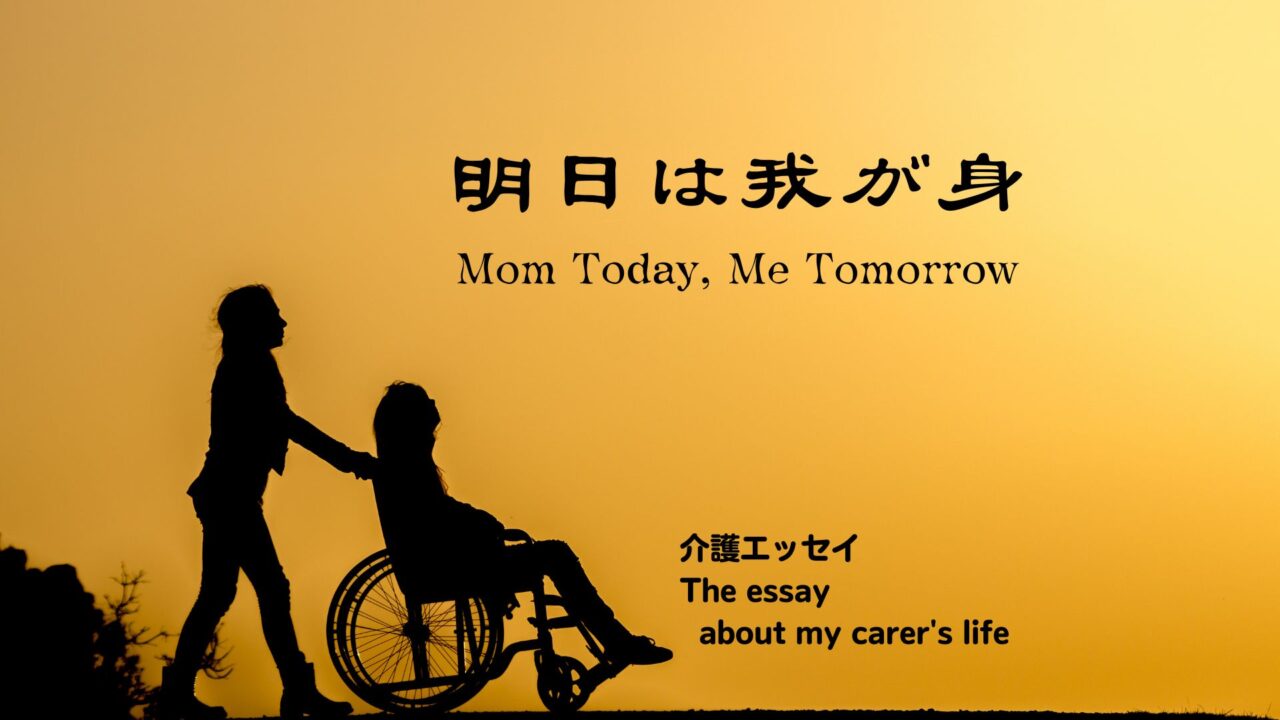
The essay about my carer’s life “Mom Today, Me Tomorrow”

編集委員会(スタッフ)/Staff 01
29/12/2024
The Japan Dementia International Exchange Platform is a place for people living with dementia and their caregivers to share experiences, feelings, and thoughts. We are looking forward to your post. Please join us.
Here is Mr. Fukui’s essay. He moved to his mother’s house in a southern prefecture from northern Japan to care for her, leaving his beloved wife and cats.
The Morning Routine
At five o’clock every morning, I arrive at Mom’s house by bicycle.
It is still dark before dawn. There is not yet the slightest hint of sunrise. Using the detachable light from the front of my bicycle, I unlock the front door and step inside.
Today is Monday. Another week begins.
Then again, life with Mom over the past two and a half years has been less about new beginnings than about repetition. Each morning I leave my apartment before sunrise, come to her house, get myself ready for the day, take care of the household chores, and then head off to work just before seven-thirty.
“Work” may be overstating it. I spend four hours each morning as a custodian at the elementary school a one-minute walk from home.
Lately, Mom has been sleeping later and later. Most mornings I leave for work without ever seeing her.
On the rare occasion she wakes around six, the conversation is almost always the same.
“Is it morning or night?”
“It’s morning.”
“Can I sleep a little longer?”
“Of course.”
And back to bed she goes.
This morning was no exception.
Monday is one of her day-care days. The staff usually arrive a little after nine to pick her up, so before leaving I packed her change of clothes for bathing, prepared breakfast, and headed out the door.
Losing Track of Time
One of the hallmarks of Alzheimer’s disease, I’ve been told, is disorientation—the gradual loss of one’s sense of time and place.
Mom loves her home. These days she rarely steps beyond the property line, so wandering off or getting lost is not much of a concern. Whether her sense of space remains intact or not, it causes few practical problems.
Time, however, is another matter.
Every morning, after saying good morning, she asks the same question.
“What day is it today?”
In fact, I sometimes joke that the only reason we still subscribe to a newspaper is to answer that question.
When I point to the date printed beneath the newspaper’s masthead, she relaxes.
“Oh, it’s already June. Time flies.”
Curiously, she will accept the newspaper’s date but not the large digital clock sitting right in front of her, despite the fact that it displays not only the date but the temperature as well.
She is equally obsessed with her age.
You would think that after ninety, a year or two one way or the other wouldn’t matter much.
Not to Mom.
The problem is that she can never remember the number.
If you open the drawer beside her usual seat at the dining table, you’ll find a patch painted over with correction fluid. Across it, written in thick black marker, are the words:
“Reiwa 6. Age 96.”
Last year, naturally, the same spot read:
“Reiwa 5. Age 95.”
Longevity is one of Mom’s favorite topics of conversation. Every day, before delivering her well-rehearsed speech, she pulls open the drawer and checks the number.
“I’m ninety-six years old. I don’t take a single pill. I can still walk by myself and go to the bathroom by myself. I’m the oldest person in the neighborhood.”
Recently, during an assessment for her long-term care certification, a caseworker asked her age.
“Ninety-three,” Mom replied.
I am almost certain she wasn’t trying to shave a few years off her age.
The drawer simply wasn’t nearby.
The Art of Letting Things Pass
Lately, relatives and friends who have long since passed away seem to reappear in her mind.
“How is so-and-so doing?” she asks.
At first I answered honestly.
But each time I reminded her that someone had died, she reacted with fresh sadness, as though hearing the news for the first time.
Eventually I began dodging the question.
“I wonder.”
“Why don’t you give them a call?”
More recently, I have become lazier still.
“Not sure.”
“Hmm.”
Sometimes I hardly answer at all.
When I first started living with her, I told myself that this could one day be me. I imagined that thought would make me patient and kind.
Instead, I find myself drifting further and further from that ideal.
These days, when Mom speaks to me, I often struggle to respond at all.
I feel guilty admitting it, but being talked to has itself become a source of stress.
That is why my four hours at the elementary school matter so much.
It is a place I am expected to go.
A place where, for a little while, I can step outside the world of dementia.
A Senior Citizen in Good Standing
A minute’s walk brings me to work.
There are flower beds to water, weeds to pull, papers to copy, fish tanks to clean, trash to collect.
Most importantly, there are children and teachers—people with whom ordinary conversations are still possible.
And because I am the oldest employee there, everyone treats me with a kind and respectful deference.
Outside Mom’s house, I too am unmistakably an elderly man.
Today’s routine assignment was trash collection.
Carrying a fresh garbage bag, I made my usual rounds through the school building, finishing, as always, at the principal’s office.
I knocked.
The principal was inside.
“Sorry to interrupt. Do you have any trash you’d like me to take?”
“Oh, thank you,” he said. “Tomorrow is garbage collection day, isn’t it?”
“That’s right,” I replied. “Friday is burnable trash day.”
The principal stared at me for a second.
Then another.
Finally he nodded.
“Yes… thank you for your hard work.”
I left the office.
The door closed behind me.
And then it hit me.
Disorientation.
My own little episode of it.
Mom today, me tomorrow…
Except tomorrow wasn’t Friday.
It was Tuesday.
Written by Fukui
Translated by Yuko MAKINO (staff)
編集委員会(スタッフ)/Staff 01
See other articles from 編集委員会(スタッフ)/Staff 01→