Declaration of the Rights of Families Living with People with Dementia

編集委員会 / Editorial Office
05/03/2026
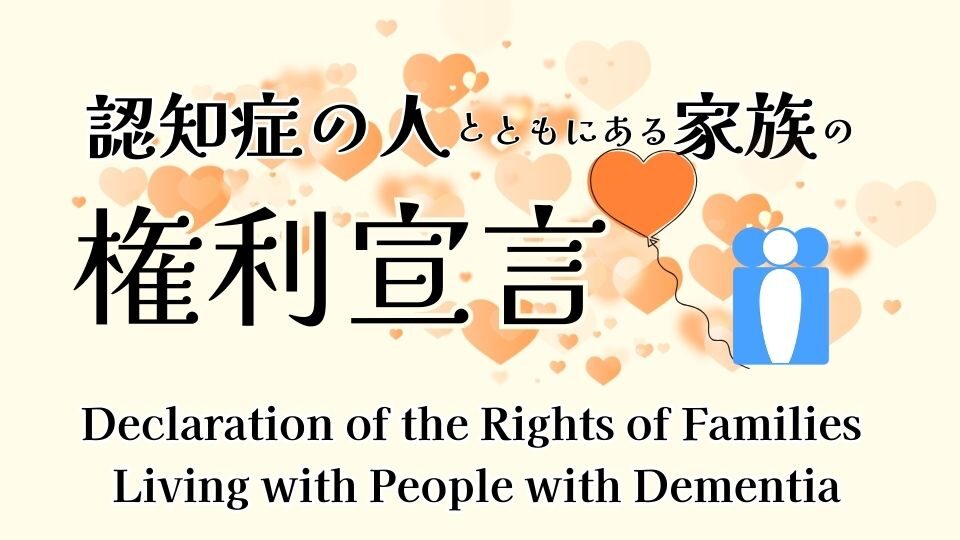
At our General Assembly in June 2025, Alzheimer’s Association Japan (AAJ) officially proclaimed the “Declaration of the Rights of Families Living with People with Dementia.”
Since our founding in 1980, we have dedicated ourselves to a single vision: a world where everyone—whether living with dementia or supporting someone who is—can live each day with peace of mind and undiminished human dignity.
With the enactment of the “Basic Act on Dementia to Promote the Realization of an Inclusive Society” (the Basic Act on Dementia), we are more determined than ever to realize a society where people with dementia, their families, and their loved ones can support one another, find purpose in life, and spend their days with a sense of security and fulfillment.
While the Basic Act on Dementia is a long-awaited milestone that we hope will enhance support for both individuals and families, we cannot overlook the significant gap that still exists between the support provided to those with the diagnosis and the support available to their families. Both are two sides of the same coin; support for families must be as robust as support for the individuals themselves.
Both people living with dementia and their families possess the right to self-determination and the right to participate in all aspects of society. To ensure an environment where human rights are never compromised, it is essential to guarantee the dignity and rights of every individual. This requires the promotion of robust social systems, financial assistance, and peer support—where those with shared experiences can lift each other up—so that everyone can pursue health and happiness.
It is with this hope for comprehensive family support that we have authored the “Declaration of the Rights of Families Living with People with Dementia.” We issue this declaration today so that our message may reach the hearts and minds of all people.
1. Respect for the Dignity and Human Rights of Each Family Member
Family members, like the person living with dementia, have the right to have their dignity protected as individuals and the right not to give up on their own lives. Every family member’s perspective and feelings must be respected and valued.
2. Guaranteeing a Society Where Families Can Live Together with Peace of Mind
An environment is essential where families can live securely alongside the person with dementia. Family members have the freedom to choose and continue their careers, as well as the right to receive financial support to maintain their livelihoods.
3. Ensuring Families Can Access Necessary Support
Every family member has the right to receive support tailored to their unique situation, ensuring that the right help is available at the right time.
4. Providing Support Through Society as a Whole
We call for a society that correctly understands the circumstances of families living with dementia and shares the responsibility of care across the entire community.
5. Utilizing the Lived Experiences of Families for the Benefit of Society
Peer support—the mutual aid between those with shared experiences—is a powerful force for society as a whole. We seek to build a society where the wisdom and experiences of people with dementia and their families can bridge the gaps that formal systems cannot reach.
Being with a person living with dementia
Everyone faces challenges with dementia.
The necessity of preparation even before its onset.
Due to the nature of dementia—where functions essential to human dignity, such as memory, orientation, and judgment, are easily impaired, and symptoms progress gradually—both the individuals diagnosed and their families often face confusion and anxiety following a diagnosis. However, some people experience less distress. These are the individuals who possessed knowledge and understanding of dementia and were already prepared even before the diagnosis.
Even if one’s preparation is insufficient, it is vital to gain correct knowledge and understanding from the early stages of diagnosis (or preferably even before) and to avoid becoming overly pessimistic about the diagnosis itself. To manage dementia effectively, it is crucial to connect early with others living through similar experiences (peers, including people with dementia and their families). Sharing effective coping methods and supporting one another through peer support is highly effective.
There are many people living positively while overcoming their confusion and anxiety together.
Nevertheless, even with such understanding and action, individuals with dementia may gradually face difficulties in their social lives and relationships, leading to personal distress. Likewise, those around them and their family members often struggle with how to provide appropriate care and support.
The necessity of continuing what one can do, while thinking and supporting one another through shared challenges.
Recently, the timing of dementia diagnosis has become earlier. At the point of diagnosis, many people with dementia are still able to manage their daily personal tasks independently and can continue working with minor adjustments and some assistance. Despite this, many people still hold the misconception that a dementia diagnosis immediately necessitates full-time care.
While awareness of cognitive decline often starts with confusion regarding dates and locations or forgetting steps and procedures, what is needed at this stage is not “caregiving” in the traditional sense, but rather “support and assistance in thinking together about lifestyle adjustments.” Daily life assistance, such as help with toileting, mobility, eating, or managing daily routines—so-called “nursing care”—is not necessarily required right away. Instead, what is essential is support that involves thinking and navigating these challenges togeth
Toward the realization of the hopes of people with dementia: Creating a future together with people with dementia and their families.
The Japan Dementia Working Group (JDWG), a general incorporated association led by people living with dementia who engage in nationwide activities alongside diverse stakeholders, issued the “Hope Declaration: Living Together with Dementia” in 2018. This declaration became a powerful driving force behind the enactment of the Basic Act on Dementia.
This “Hope Declaration” defines a personal philosophy and way of life—how each individual can live with dignity and hope while navigating various hardships. It is a proclamation of the determination and resolve to live hopefully with dementia, reflecting a “work-in-progress” mindset and a commitment to building a better society together.
We believe that the issuance and realization of this Hope Declaration serve as a source of strength and a foundation not only for people with dementia but also for their families. We hope that families living with dementia will also expand the circle of those striving to live with hope and those working together to build a better society. Our goal is to co-create a world where both people with dementia and their families can live with ease and fulfillment.
The Necessity of a Declaration to Society for Families Living Alongside People with Dementia
As we strive to build a society where people with dementia can live with ease, it is equally essential for the families living alongside them to continue their lives with hope and authenticity, without giving up on their own aspirations. Just as family members wish for each other’s happiness, imposing an excessive burden or sacrifice on a single individual can lead to the breakdown of family relationships, making it impossible for the entire family to live happily.
Furthermore, dementia is something that can happen to anyone. Within a supportive network, it is possible for any family member to develop dementia, including those who are currently providing care. To ensure the happiness of both people with dementia and their families, and prompted by the enforcement of the Basic Act on Dementia, we felt it was necessary to issue a “Declaration of the Rights of Families Living with People with Dementia” in harmony with the “Hope Declaration” made by people with dementia.
The rights listed here are based on the fundamental human rights guaranteed under the Constitution of Japan. As those closest to the person with dementia—serving as companions, advocates, and partners—families are often called upon to speak for the person’s wishes when necessary. However, for many families, facing dementia is a “first-time” experience, and they may not know how to respond. Even for those with experience, the symptoms vary from person to person, and living with dementia remains a challenge. Therefore, through this declaration of rights, we call for the necessary social support to ensure that family members can maintain their dignity as individuals and live with peace of mind alongside the person with dementia.
We hope to establish a common social understanding that empathizing with the feelings of families and enhancing family support is essential to enriching the lives of people with dementia. In our pursuit of the inclusive society envisioned by the Basic Act on Dementia, we hereby make this declaration.
Note: Defining “People with Dementia and Their Families”
Note 1: Definition of “Parties Affected by Dementia”
We consider the parties affected by dementia to be both the individuals living with the condition and their family members who share in the challenges it brings.Note 2: Definition of “People with Dementia”
In this context, we define “people with dementia” as individuals who are distressed by cognitive decline, regardless of the severity of their symptoms or whether they have received a formal diagnosis. While the term traditionally refers to those clinically diagnosed with dementia, the emergence of disease-modifying drugs has led to more people being diagnosed with pre-dementia states or Mild Cognitive Impairment (MCI). Although these individuals do not strictly fall under the clinical definition of dementia, they still experience significant anxiety and distress due to cognitive decline. Dementia is a syndrome caused by various underlying diseases; its symptoms and progression vary significantly depending on the specific disease and the individual. Because it cannot be categorized into a single experience, everyone faces their own unique struggles with dementia.Note 3: Definition of “Family”
We believe that “family” consists of individuals who share blood or marital ties, or those who, regardless of such ties or living arrangements, maintain a deep connection and recognize each other as family. Family is the smallest social unit, composed of two or more people. Under the Japanese Civil Code, “relatives” are defined as “blood relatives within the sixth degree of kinship, spouses, and relatives by affinity within the third degree” (Article 725), and it states that “lineal blood relatives and relatives living together must support each other” (Article 730). However, there is no absolute definition of “family.” Those bound by blood or marriage influence one another deeply through their shared history and past relationships. The concept of “mutual support” (たすけあい, tasuke-ai) encompasses caring for, assisting, and sustaining one another. In reality, the circumstances and feelings surrounding this support vary greatly depending on the relationship. A family is a bond of interconnected fates that are often inseparable.
編集委員会 / Editorial Office
公益社団法人認知症の人と家族の会は1980年に結成された、認知症の人と家族・介護者が結成した民間の団体です。
See other articles from 編集委員会 / Editorial Office→